

How Arduino sped up its educational projects
The renowned hardware and software company needed a new content architecture to manage its ever-growing portfolio of educational products. Working with Cantiere Creativo, Arduino can now build and manage new products much faster, and with far greater satisfaction.
The renowned hardware and software company needed a new content architecture to manage its ever-growing portfolio of educational products. Working with Cantiere Creativo, Arduino can now build and manage new products much faster, and with far greater satisfaction.


Arduino by the numbers
fewer lines of code
-95,2%
average load time
-50%
faster than the industry average
+52,3%
More content in less time
The new architecture lets the team build new sites and content modularly, reusing shared parts with zero effort.
The new architecture lets the team build new sites and content modularly, reusing shared parts with zero effort.
Faster load times across the board
The new project websites perform far better than the industry standard.
The new project websites perform far better than the industry standard.
A streamlined editorial workflow
The editorial team can work alongside the development team without worrying about breaking anything.
The editorial team can work alongside the development team without worrying about breaking anything.
Thanks to the platform's flexibility and great support from Cantiere Creativo, it was easy to integrate the mockups created by our design team and tailor the platform to our needs
Ernesto López Canelón
Product owner | Arduino
Breaking free from a monolithic architecture
Arduino needed to improve content management for its Educational section and all related products, because the legacy monolithic CMS it was using tied the team to a slow, cumbersome editorial workflow. Every time they built a new website, the development and editorial teams had to recreate content and pages from scratch, wasting a significant amount of time.
Their goal was to move to a CMS that would let them easily replicate sites and content while keeping performance excellent and security uncompromised. That is why they chose a headless CMS.
Looking for an experienced agency
Headless CMSs are a growing market because they let you manage all your content from a single central hub. They are also API-first, so teams can work with their preferred development languages. The hard part is often finding an agency able to work with an architecture that is still relatively unexplored in the mainstream.
After choosing DatoCMS as its technology, Arduino reached out to Cantiere Creativo, the agency where the product was born.
The flexibility of DatoCMS and Cantiere Creativo's experience would allow Arduino to work on its content architecture while developing the interface in a reasonable timeframe, dramatically improving its workflow.

A fast, clean system
Cantiere Creativo developed a system that combines best-in-class speed with greater efficiency and cleaner code.
The homepage now loads in 2.4 seconds on average, a full 2.1 seconds faster than the education industry average. Yet the biggest leap forward came in how fast internal pages load.
Given the sheer volume of content and its many dependencies, the old system took up to 8 seconds to open each internal page, while the new structure loads them almost instantly, in milliseconds.
A substantial optimization effort also cut the codebase from 26,107 lines in the previous version to just 1,267 today, a 95.2% reduction.
DatoCMS + React
A first project was built with DatoCMS and React (the new language Facebook is built on), so it could then serve as a foundation for other projects by "duplicating" the shared parts.
React displays content much faster than other languages because it does so intelligently, loading only the parts of the interface that change from one page to the next.
The language is highly modular, so it's easy to take apart and reassemble at will, delivering many different solutions with small changes.
Like React, DatoCMS makes flexibility its key strength, thanks to features such as "Modular Blocks", which let you create content blocks that can be placed anywhere in a page's structure and reused effortlessly.
"Thanks to the platform's flexibility and great support from Cantiere Creativo, it was easy to integrate the mockups created by our design team and tailor the platform to our needs," says Ernesto López Canelón, hardware designer and product owner at Arduino.
DatoCMS also supports strict validation rules, so the editorial team can work on content without fear of breaking anything when new content is published.
Training and workshops
Arduino was enthusiastic about the product, but at first the team found it hard to enter content correctly. After a joint review of the pain points, Cantiere Creativo's CTO and project manager flew to Arduino's two European offices (Malmö and Turin) for four days of training, wrapping up with a workshop designed to streamline the work.
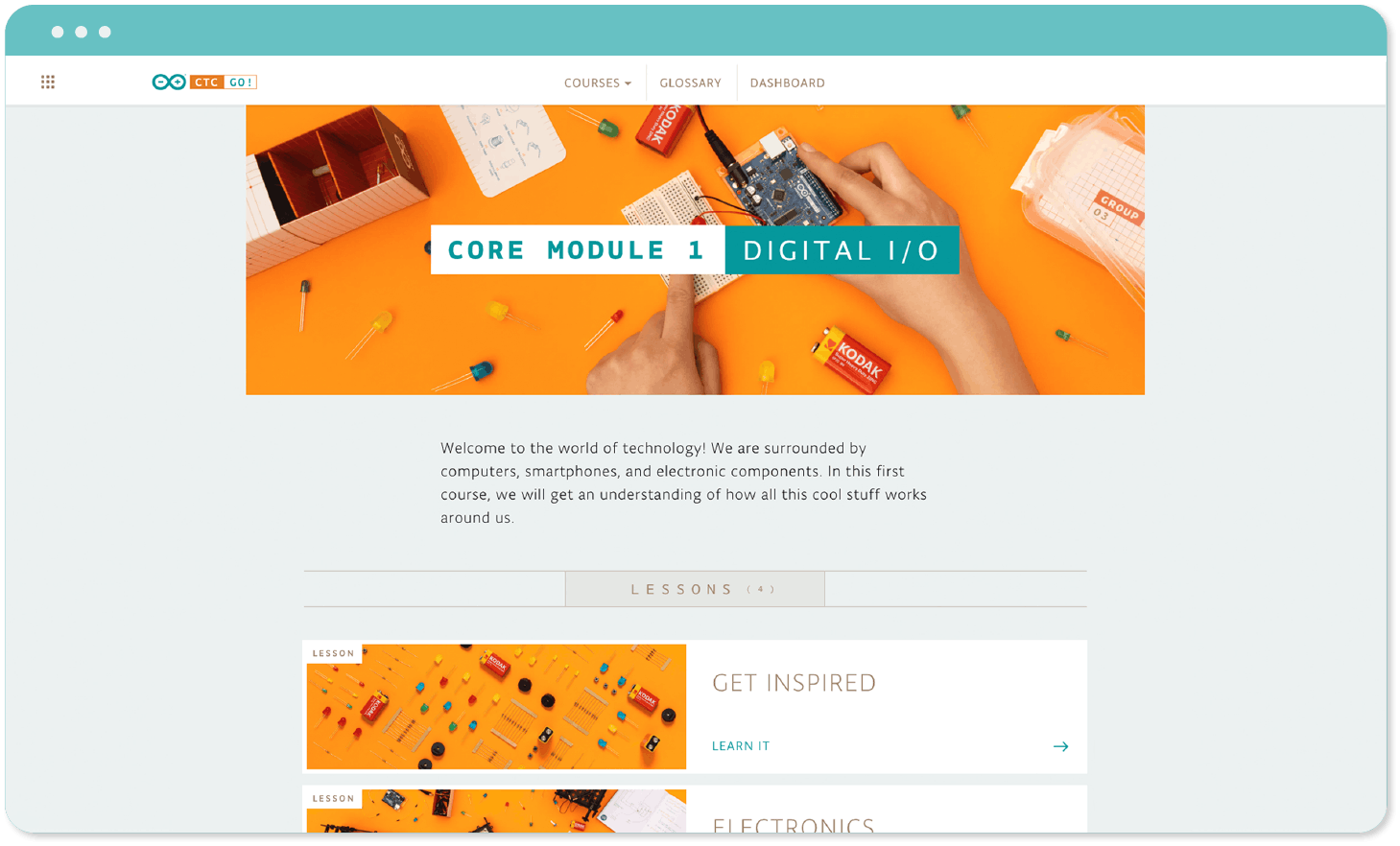
"Onboarding was a bit of a challenge for the team at first, but after the training sessions and ongoing support from Cantiere Creativo, we're now much more confident working with DatoCMS and more aware of its potential," says Carla Muñoz Sedze, product owner of Arduino CTC GO!
The workshop was also a chance to exchange ideas and listen, so that the relationship between Cantiere and Arduino would go beyond content architecture alone.
The conversations were so productive that they sparked new joint projects between the two Italian companies:
- a DatoCMS plugin that automatically translates content, integrating with multiple translation services such as Yandex and Transifex.
- an automated Markdown linter that checks how content has been entered against the client's requirements and then corrects it.
A relationship that goes beyond maintenance
Arduino and Cantiere continue to collaborate on a range of projects, including the plugins conceived during the four days of training.
