



Summary
Over nine months, we:
- Defined a strategy
- Ran User Research sessions
- Bought traffic to landing pages
- Organized local events
- Developed an events platform
Results
- 29 events organized (in the three months after launch)
- 2500 users
- €80,000 in funding from the Region
What is MyShindig
MyShindig is a portal for special gatherings called “shindigs”: non-commercial events like an evening on a rooftop, in a garage or by a friend's pool. The portal lets organizers create an event and lets people join it.
Meeting Emanuele
The day Emanuele walked into Cantiere Creativo, he immediately struck us as a sharp guy, and after talking with him, he had everything it takes to be one. In the startup world, finding smart, driven young people is good; finding ones with previous experience in web entrepreneurship (maybe even with a few failures behind them) is excellent, and rare.
The platform's problems
When Emanuele knocked on our door, he had spent two years working full-time on his project, MyShindig, first going through SpeedMIUp, the Bocconi-backed Milan accelerator, and then through Florence's own Nana Bianca. By the time the portal reached us, it wasn't in great shape.
Before working with you, our platform had serious IT infrastructure and data security problems. Many sections of the site didn't work and the user experience was terrible, so lots of users dropped off and we couldn't convert.
Emanuele - CEO of MyShindig.events
Challenges
- Build a portal that's fast, beautiful and user-friendly
- Target the right users
- Build a community that stays loyal
- Do networking and branding locally
Project kick-off
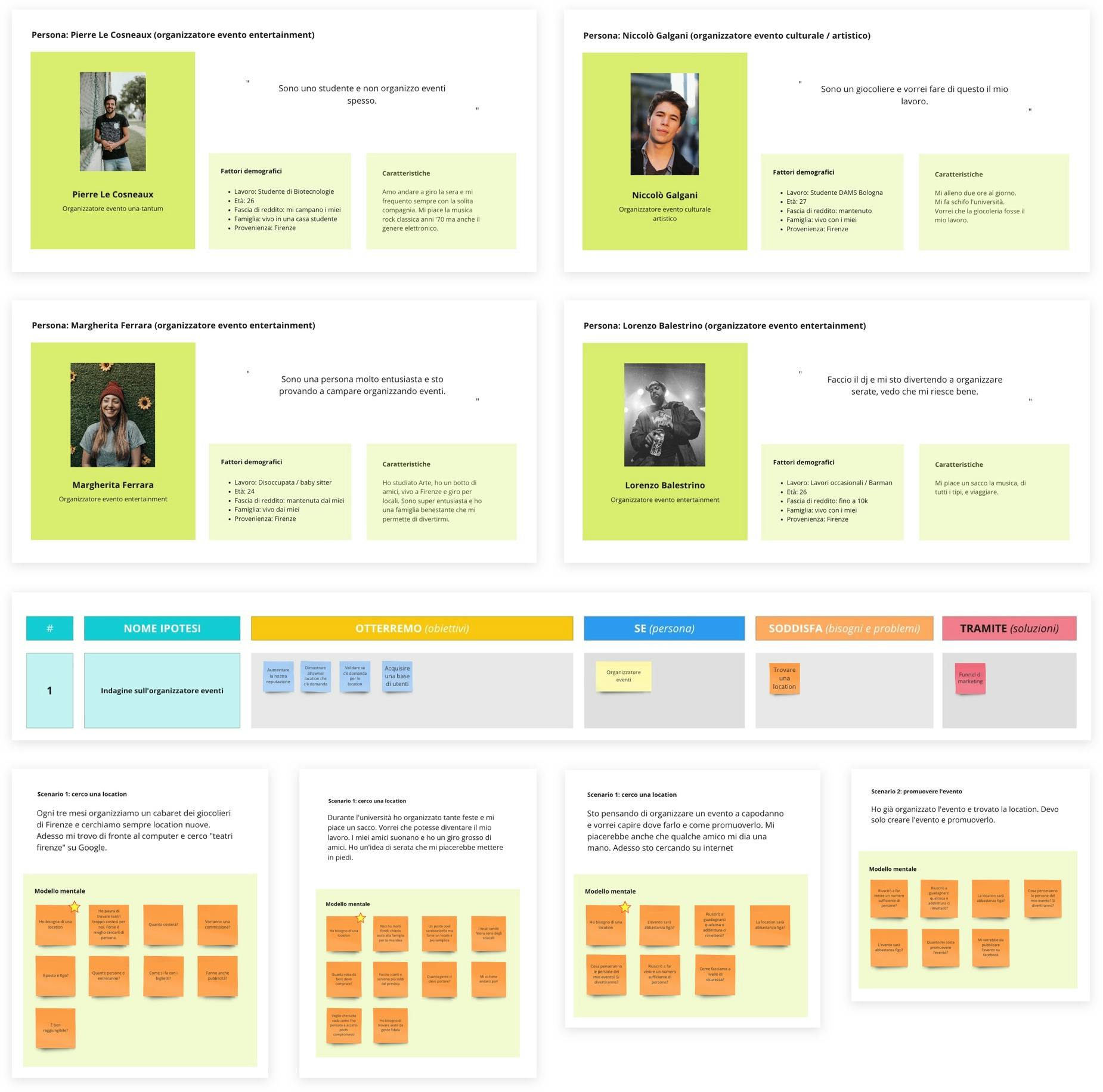
We invited Emanuele to our office and, using Lean UX and Design Thinking exercises, produced all the material we needed to clarify the target audience and the strategic direction.
This working session lasted four hours and took place in a room equipped with whiteboards, A3 sheets, Post-its and stationery. Here are some of the outputs.

The hypotheses
This is a great start: it helps clarify ideas and lay the foundation of a “strategy machine”, as well as a user-centered design process, but… they're only hypotheses.
At this stage, we hypothesize that:
- our target users are amateur event organizers;
- venue owners (where events take place) are our potential revenue generators;
- Milan and Florence are our first markets.
The risks
During the Lean UX work, we asked ourselves:
Which issues, if true, would cause the entire project to fail?
The answers concerned the venues that would host the shindigs (because that's where we assumed we'd make money).
Here are the issues that, if true, would make us fail:
- Venue owners find that through us they don't get any rental requests
- There aren't enough venues that fit the shindig style for the business to be sustainable
- The system for contacting a venue owner can be bypassed
- Venue owners aren't willing to pay for a subscription
Well, if these are the risks, let's tackle them right away.
A quick aside
The Lean UX methodology is built on eliminating business risks as quickly as possible.
- Wrong way: I spend two years developing a platform before knowing whether users will ever use it.
- Right way: I spend three weeks building a landing page that simulates (or actually performs) the primary action users would take on the platform, then I observe their behavior.
Now let's look at how we worked on the risks.
Experiment 1: venues, come to us!
In this phase, we created a first version of MyShindig. The homepage stated our mission (organizing shindigs), but inside it only showed a directory of the (few) venues that had already signed agreements with us.


The key to this experiment is time to launch.Designed in: 12 hours.
Developed in: 40 hours. Within three weeks we were live.And the experiment?Emanuele (with his business partner) spent a month and a half contacting venue owners in Florence and Milan, first by email (showing them the website) and then meeting them in person.Results?
- We contacted around 50 venues in person.
- We signed agreements with 20 venues that were listed on our website.
What did we learn from these conversations?
- That Florence is a tougher market than Milan.
- That none of the venue owners would accept MyShindig taking a commission (they would bypass us after the first contact).
- That at least 70% would accept an annual subscription.
What now?Time to investigate event organizers:
- Would they ever use MyShindig?
- Is our target really first-time organizers?
Experiment 2: organizers, over to you!
We created a landing page for event organizers, and this time we also gave it a design pass:

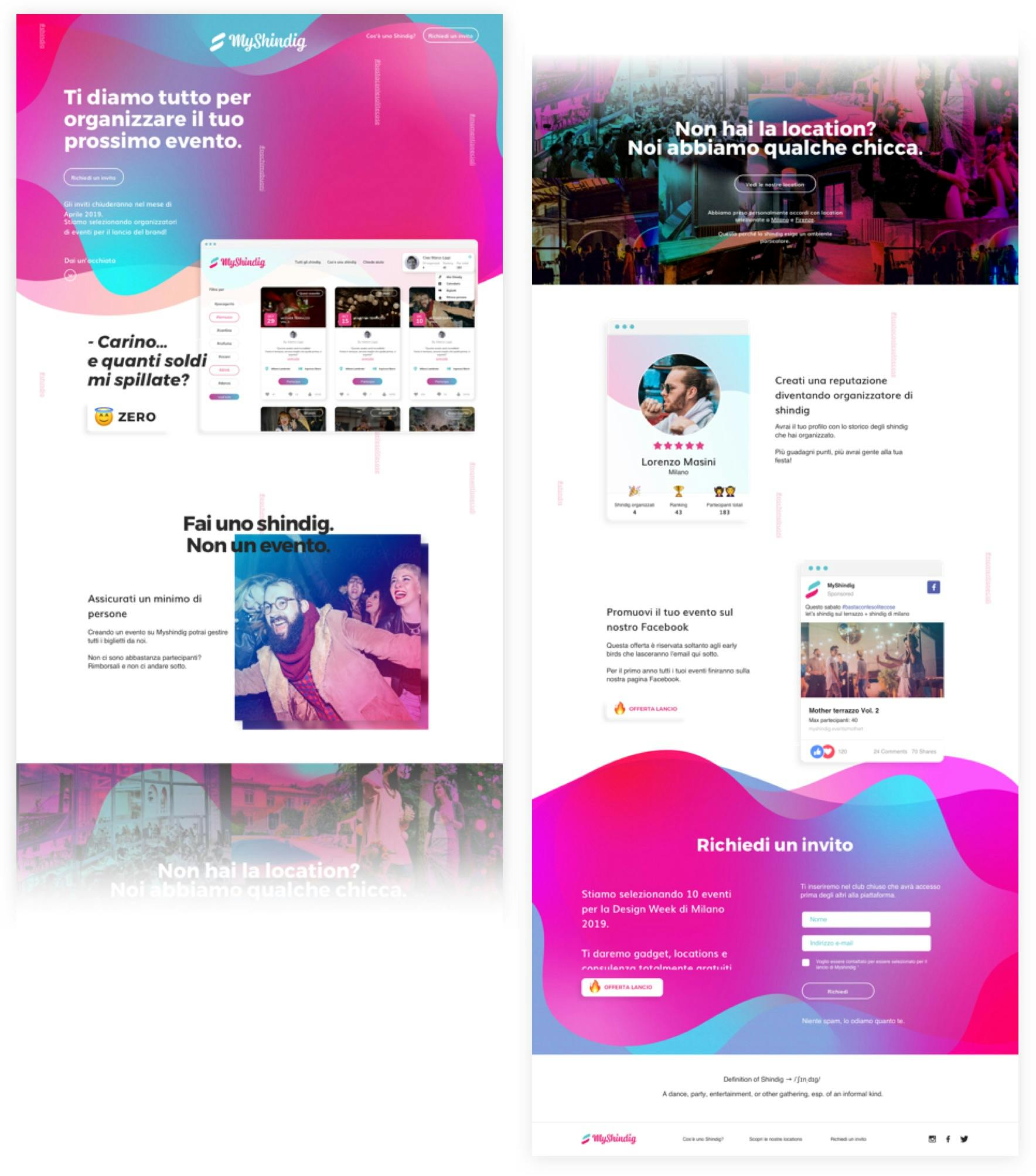
This time, the pages didn't get visits only through word of mouth, but also (and mostly) through traffic bought on Facebook.Results?
- We collected around 800 organizer emails.
- We received about 100 inquiries through the Intercom chatbot in the bottom right corner.
- We started partnerships with several organizers in Milan.
- We organized 4 MyShindig-branded events in Milan.
- At every event, we collected attendees' emails.
What did we find out?
- That our target isn't amateur organizers but semi-professionals.
- That there's a lot of interest from organizers.
- That organizers expect us to give visibility to their events, not just a platform.
This second experiment was full of pleasant surprises. On top of the venue agreements, we now had several partnerships and a good number of organizer and attendee contacts. We had also validated interest and spoken directly with our target, often in person. Now we had everything we needed to build the first version of the platform.
Experiment 3: the platform
The first questions came up right away:
- If we launch the portal with no content, will we look bad?
- What will our launch campaign be?
After a series of meetings, we defined the launch strategy. Before the portal existed:
- we take charge of the logistics for a few events in Milan completely free of charge (providing the venue, swag, performers, etc.);
- we build a personal relationship of trust with the organizer;
- we use Eventbrite to manage the event for them.
At launch:
- we move all the events managed so far from Eventbrite to MyShindig.
That way, when we launch the platform, it already has live events and incoming traffic. And that's how it went. More work, but done at the right time and with the right cards in hand:

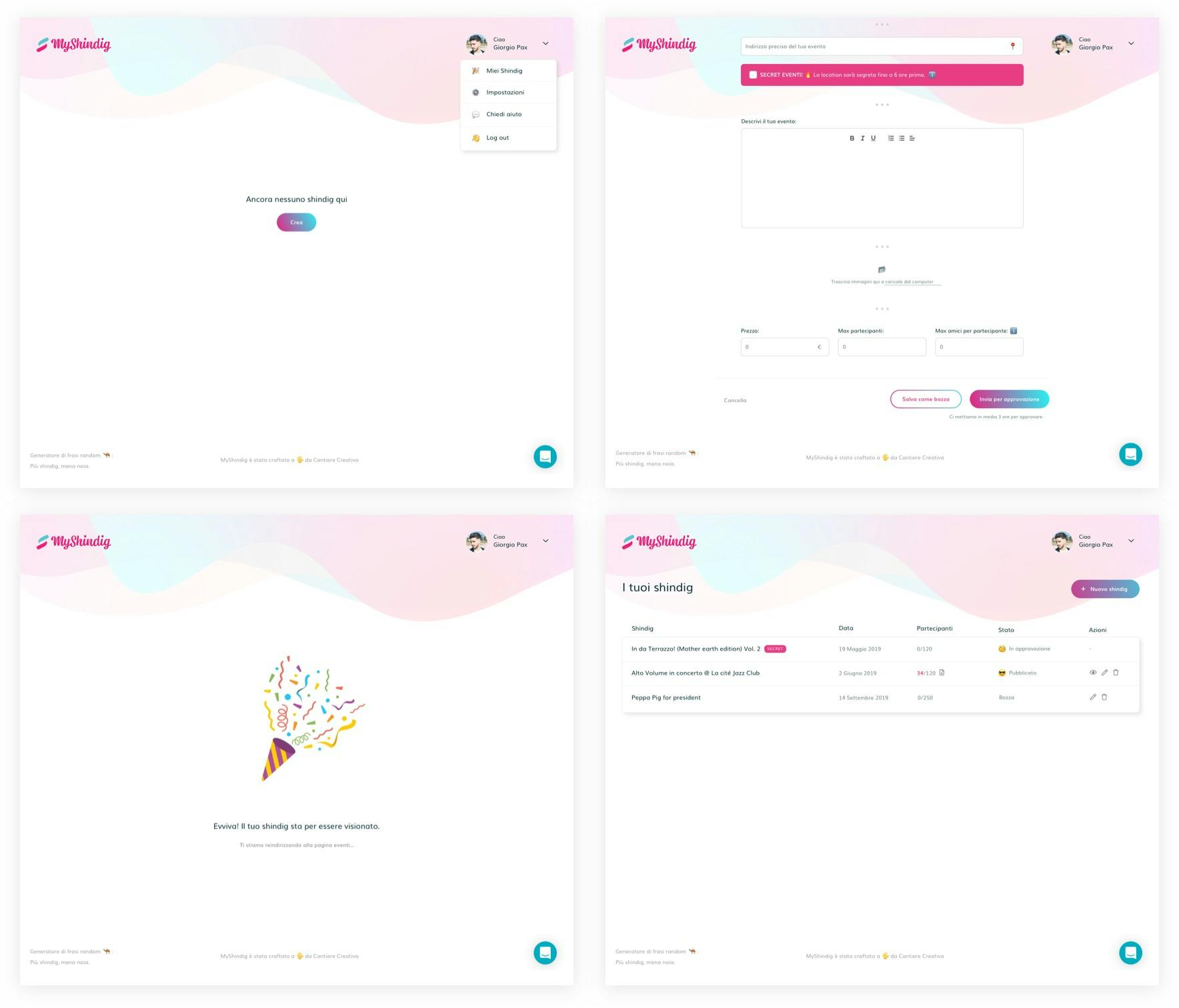

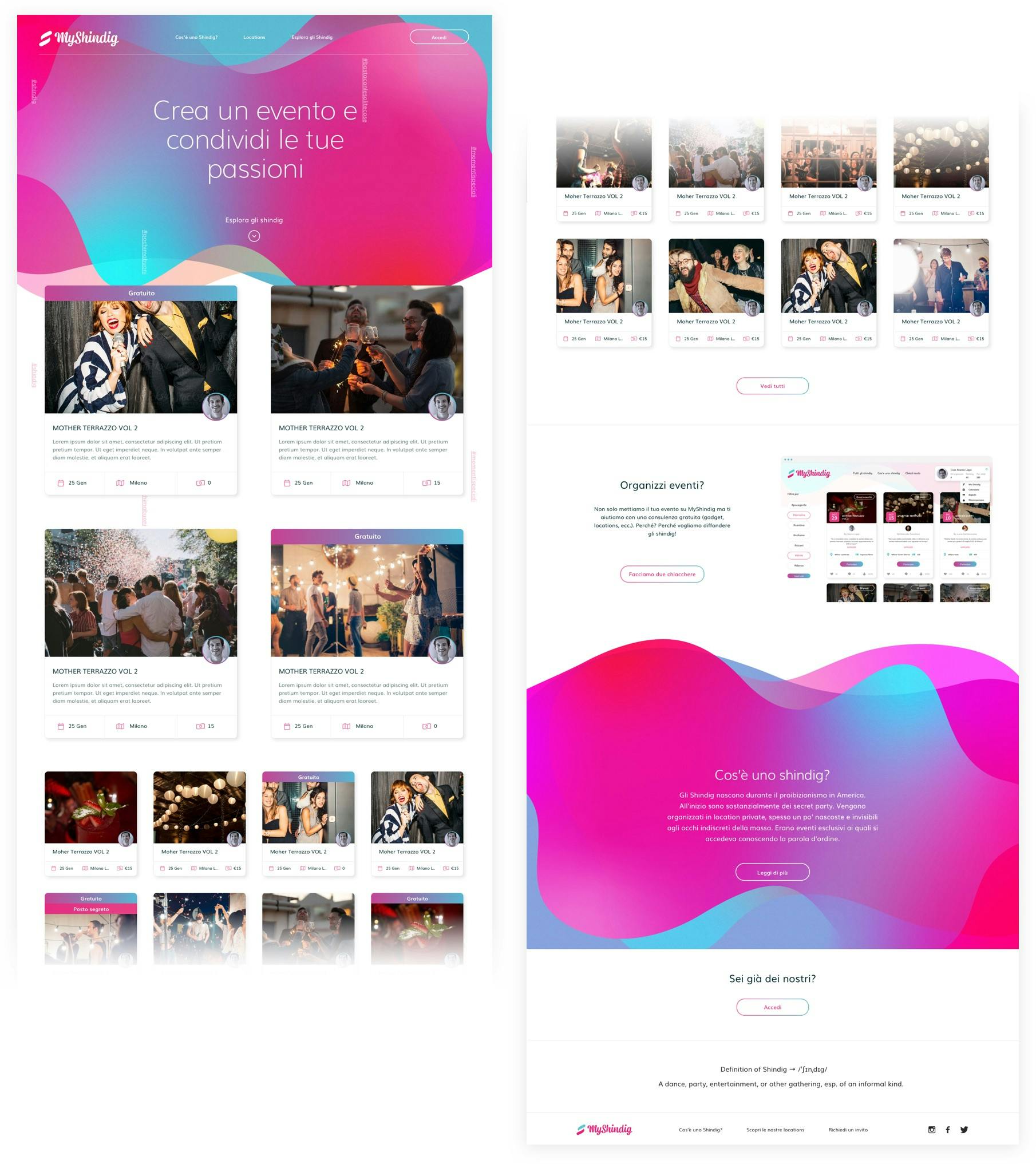
We went live in July 2019 with 5 events already listed and 4 in the pipeline. From then on, we worked differently.
Ongoing development
At this point, we had everything we needed to commit to proper ongoing development.What has happened since launch?Not everyone knows that you really start designing a site once it's already live. Emanuele is definitely one of the few who get it. Since launch, we have:
- fixed and developed new features based solely on conversations with users;
- grown Emanuele's team, hiring a marketing manager and a business developer;
- designed new ad campaigns with dedicated funnels;
- secured €80,000 in funding from the Region.
What are our goals now?
- Optimize the user base to build a community of real value.
- Design a small monetization system.
- Keep developing around what users want.
Conclusion
A Lean UX-based project like MyShindig is very rare. On average, we hear from a startup every two days, and we rarely meet someone with the entrepreneurial maturity this kind of journey requires. Working with a Lean approach means focusing on results more than on the product, so you never know what's coming and you don't have the (false) certainty of a roadmap. All you know is that you need to collect value, and do it fast, through small experiments, while always keeping a long-term vision. Today Emanuele doesn't just have a portal and a community (which still has a lot of growing to do): he has absorbed strategic tools and become a lean entrepreneur.


