
Workshops: the secret to lasting client relationships
A Content Marketing workshop is a growth opportunity for clients, helping them become aware of their own identity. Let's see how a good digital marketing workshop turns out to be a great way to build a lasting relationship with clients.
A Content Marketing workshop is a growth opportunity for clients, helping them become aware of their own identity. Let's see how a good digital marketing workshop turns out to be a great way to build a lasting relationship with clients.


Why run a Content Marketing workshop?
A Content Marketing workshop aims to support clients in brainstorming, both while designing the sitemap and while adding content.
Once they have their new website in hand, many clients struggle to write copy that is consistent with their positioning.
So the goal is to guide them as they define their identity.
Which canvases do we use?
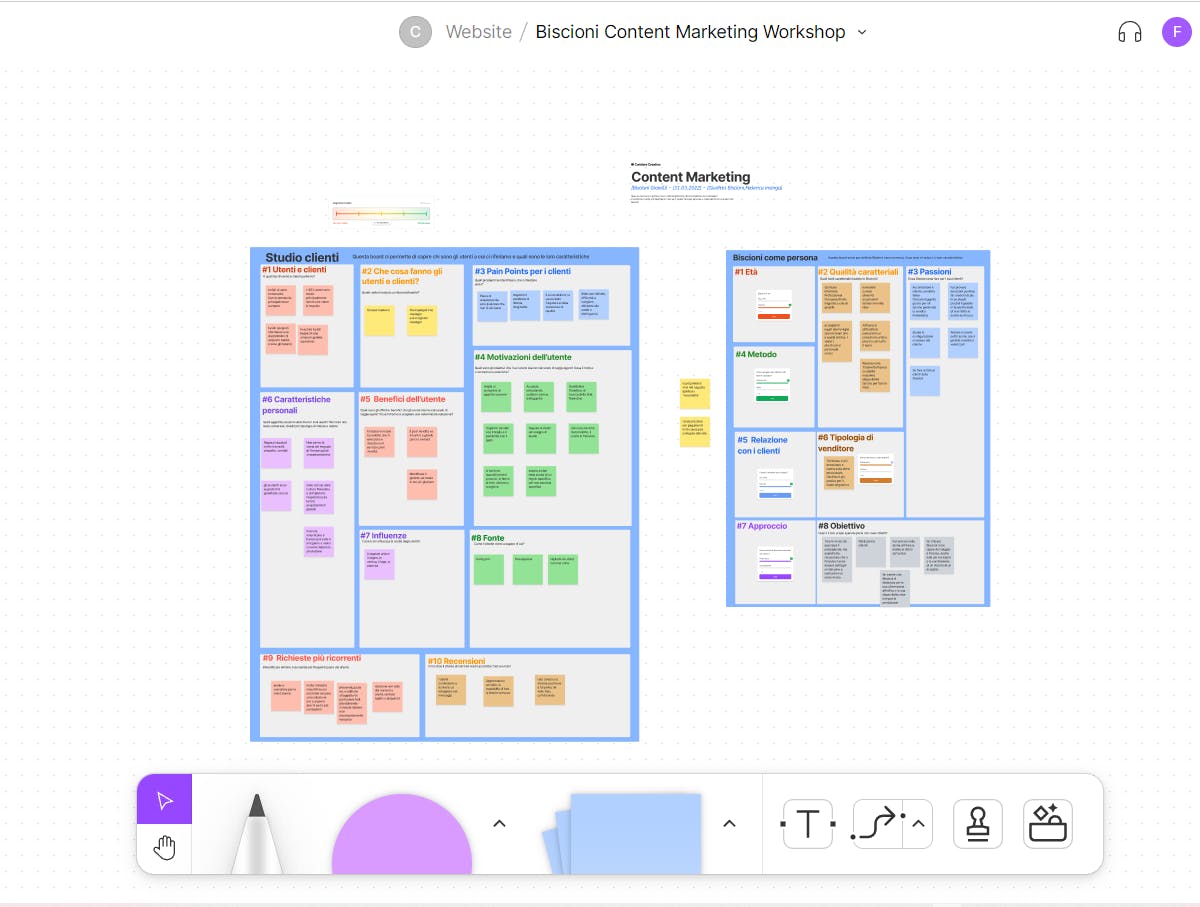
The tone of voice workshop template follows the buyer personas and positioning canvases. The brainstorming questions are split into two phases.
In the first, we study the customers, asking a series of questions about
- who the users and customers are: what kind of users and customers are we talking to?
- what users and customers do: what is their professional role?
- customer pain points: what problems or needs have you identified in your customers?
- user motivations: what goals are your users trying to reach? what drives them to look for a solution?
- user benefits: what are the benefits of reaching the goal? what are the benefits of the solution?
- personal traits: which adjectives describe your users? If they don't apply to everyone, we split them by customer and user.
- influences: what and who influences users' choices?
In the second board we ask clients to imagine their company as a person and answer the following questions:
- age: would you describe your company as a young or a mature person?
- character traits: what character traits do you see in your company?
- passions: what does it love doing for its customers?
- customer relationships: how well does it know the people it talks to?
- method: how does it explain its work to someone unfamiliar with it?
- sales style: how does it present its products?
- goal: what is its aim when talking to its customers?
- approach: what reaction does it try to spark in its customers?
A growth experience for everyone
This workshop was a chance to expand the model our marketing team already uses internally to define tone of voice, which we covered in another article of ours.
We realized there were other questions we could use to help clients even more. So we added these three questions to the first board:
- Source: how do customers hear about you?
- Reviews: what do customers say about buying from you?
- Most frequent requests: list at least 5 of your customers' most frequent requests.

Moving from Miro to Figma
The tone of voice workshop template, originally built in Miro, was moved to Figma.
Each question from the previous section was paired with a color and a number. This lets clients follow the workshop's logic step by step.
For the tone of voice section, in the second board, we used the poll widget that creates small multiple-choice boxes. This increases interaction with clients during the workshop by getting them actively involved.
Another key feature was Figma's option that lets clients follow the moderator during the workshop, simply by clicking the name initial in the top right corner.
Right after the workshop, the client started moving all the sticky notes around, so taken with the workshop that she wanted to start working on the copy right away. However, this could have jeopardized exporting the workshop's final file. The client, unfamiliar with the tool, could also have accidentally deleted the sticky notes.
Thanks to the (if you'll pardon the expression) "lifesaver" start session feature, we were able to limit the board's editing time so workshop participants could only view the content.
That's why it's essential to give the sticky notes the same color as their question: you'll be able to rebuild the board quickly!
To avoid moments of panic when the board suddenly falls apart, we recommend always using Figma's “group” and “lock” features. They keep elements from getting lost on the page and stop the template's dimensions from being thrown off with a single click.
Key takeaways from this experience
During the workshop, the conversation offers plenty of hooks that never make it onto the sticky notes but can still be put to good use.
In particular, if the site has already been built, draft copy already written by the client or content from the old site can offer interesting clues about why they care so much about a certain topic.
In this situation, clients will feel very reassured that the work they've already done can be put to good use.
We also found that clients take many aspects of how they work for granted, thinking they aren't worth mentioning on their site. That's why content often ends up quite repetitive.
We're always pleasantly surprised by how much care every company puts into its service, and the workshop leaves clients even more satisfied because they become aware of their strengths.
For example, in one of our first calls, the client asked us questions such as "do you really think the blog is necessary?".
Although we had tried to explain how essential it is for a marketing strategy, the client seemed far more aware of it to me now that the workshop has taken place.
In fact, when she described in detail how she advises her customers on purchases, some very interesting ideas came up for new blog posts that set her apart in the market.
Why does a workshop build lasting partnerships?
Although the main goal is getting the site live, there's no denying that a workshop like the one described above is the perfect start to a lasting relationship with clients.
Once the site is live, it will need search engine optimization work, which clients generally tend to outsource if they don't have an in-house marketing team.
Cantiere Creativo's marketing team has handled on-page SEO and metadata several times, achieving truly measurable ranking results in the medium to long term, thanks to the Moz Pro tool.
When you talk about Content Marketing, word of mouth and the channels through which users discover a company, social media marketing inevitably comes up. In fact, the client reiterated her interest in training on writing an editorial plan for a social media strategy and on using social platforms and related tools. So here, too, a partnership between agency and client could grow, built on skills and mutual trust.
Need to write the content for your website and don't know where to start? Planning a new site and need advice on designing your sitemap? Cantiere Creativo's marketing team might have just the solution for you!
And if you're a fellow professional, we hope our experience has given you some food for thought for your own work.


