

90% of startups fail: here's how we tackle it
When we read this statistic in 2015, we weren't surprised at all. In fact, we're pretty sure any agency that has worked on the web over the last ten years already knows this phenomenon well.
When we read this statistic in 2015, we weren't surprised at all. In fact, we're pretty sure any agency that has worked on the web over the last ten years already knows this phenomenon well.


On average, a startup founder knocks on Cantiere Creativo's door every two weeks. And what do we tell them?
9 out of 10 startups fail.
Maybe not quite that bluntly, but we certainly get there. We want to be realistic and, above all, explain how we have responded to this phenomenon over the years.
First of all, we responded by taking a stand:
At Cantiere Creativo, we decided to stop accepting the mass extinction of startups and to stop working on projects whose success we can't also believe in and pursue ourselves.
In other words, we want to believe in it too and bring our enthusiasm. We don't want to be, and can't be, mere executors.
So over the years we have studied and tested, with hundreds of clients, a methodology called Lean UX, born from the ashes of all the startups that burned out along the way.
I won't go into what Lean UX is and how it works right now (we'll write an article about it soon), but I can mention that it combines three methodologies:
- Lean Startup
- Agile
- Design Thinking
Its primary goal is to reduce your business risk and design a User-Centered product.
Here's how we aim for that 10%
It may sound presumptuous, and it certainly wouldn't be right to say we'll lead you to success, because no one can offer guarantees in business. The outcome is decided by the market and many other factors. What we do, however, is apply a method that significantly reduces the risks behind startup failure. Let's see how.
1) We define the assumptions
All the work starts with assumptions.
Assumptions are the startup's beliefs about the market and its users.
More often than not, we're overconfident about the trends we perceive in the world. This confidence often comes from personal experience and from opinions, sometimes inflated by articles or “trends” that have no truly solid basis, especially within the targets we want to reach with our product.
We often casually say things like “In a few years everything will be mobile and desktop will die” or “People urgently need this” when maybe I'm the only one who strongly felt that need at a given moment in my life, and from then on I let my mind spend days and months imagining how great a certain solution would be, until I convinced myself it would revolutionize an entire industry.
Enthusiasm is fine, essential in fact, but it has to be paired with a method. Here's how we unpack the assumptions:
Assumptions Worksheet
We put these questions to the team (including the client), either through a brainstorming exercise or by asking each person to answer them privately in an individual focus session and then share their answers one at a time.
Market assumptions:
1. I believe my customers need ____________
2. These needs can be solved with ____________
3. My initial customers will be ____________
4. The #1 value a customer wants from my service is ____________
5. The customer can also get these benefits ____________
6. I will acquire most of my customers through ____________
7. I will make money through ____________
8. My main competitors in the market are ____________
9. We will beat them thanks to ____________
10. My biggest market risk is ____________
11. We will solve this risk through ____________
12. What other assumptions, if proven false, would cause the whole project to fail? ____________
User assumptions
1. My user is ____________
2. Our product fits into their life and work like this: ____________
3. Our product solves these problems / needs / desires: ____________
4. Here's when and how they use our product ____________
5. These product features are vital to them ____________
Note that assumptions aren't meant only as “beliefs”: we treat them that way because we question everything we haven't yet validated through proper research, but assumptions are actually the foundation of all our work and will eventually become our actual product.
2) Prioritize the assumptions
Once the assumptions have been discussed and defined, we need to rank them by risk. This is the risk prioritization matrix:

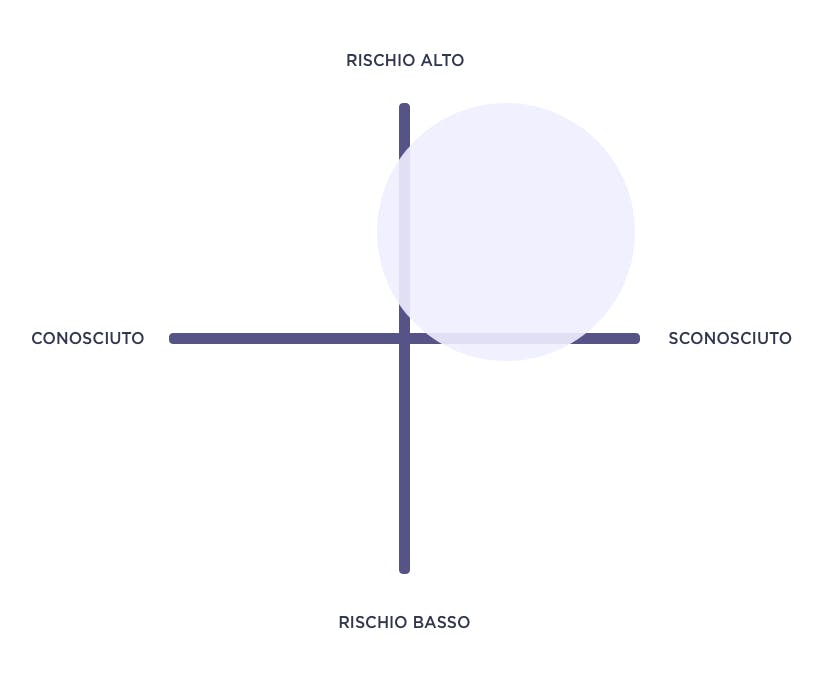
Risk prioritization matrix
3) Assumptions become hypotheses
In this phase we need to start testing the assumptions, and the best way to do that is to turn them into hypotheses.
Here's the format of a hypothesis:
We believe that
[this statement is true]
We will know we were
[right/wrong]
When we see the following signals from the market
[qualitative feedback] and/or
[quantitative feedback] and/or
[KPI]
4) We split hypotheses into sub-hypotheses
Hypotheses are very often too big, and therefore too generic, to be tested. Splitting them into sub-hypotheses helps us move toward something practical. In fact, we now name precisely the feature or experience we want to offer the user.
Here's the format of a sub-hypothesis:
We believe that building
[feature/experience]
for
[persona]
will achieve
[outcome]
We will know we were right when we see
[market signal]
[quantitative measure]
[qualitative measure]
5) Write the KPIs
The final part of this phase is deciding which performance metrics / results we want to work on.
We suggest creating a list of KPIs and having the team vote on the ones we consider best to work on.
Some examples:
- Average monthly unique visitors
- Referrals from Twitter
- Newsletter sign-ups
- Email open rate
- Payment conversion rate
The work begins
At the end of this phase we have everything we need to get started: a list of solution hypotheses ranked by priority.
We then take the first one and kick off a second workshop called Design Studio. This time, the text of our hypothesis becomes the theme of the Design Studio.
Simply put, the Design Studio is a session attended by the whole team, with exercises that stimulate creativity and problem solving, aimed at generating solution ideas that will be developed in more detail after the workshop.
A more detailed guide to the Design Studio session is available in this article.
Conclusions
This is just one part of the Lean UX work we do at Cantiere Creativo. In the article linked above you can learn more about the workshop sessions we run together.
Thanks for reading, and feel free to write to us anytime!


