

Agile at 717: a new website for Florence Cathedral
We built (and keep building) the family of websites for one of Florence's most important institutions: the Opera di Santa Maria del Fiore, the foundation that has cared for the monuments of Florence Cathedral, the Baptistery and Giotto's Bell Tower for centuries. It's one of the most important monumental complexes in the world.


Another... Cantiere for the Opera
Back in July 2013 we had created a new landing page for the Grande Museo del Duomo and added a blog to the Opera's “old” website: Opera Magazine, which effectively paved the way to the new website.


The Florence Cathedral website is finally online, completely redesigned.
With over seven hundred years of history, a symbol of the Florentine excellence that sparked the Renaissance, the Opera now matches the world's leading museums in the quality of its web presence. And Cantiere Creativo can say, with some pride, that it works for the same “company” Brunelleschi, Ghiberti and Michelangelo worked for.
And while Brunelleschi had his hands full designing and raising, with his own building site, the tallest dome ever built, we had to solve problems that were certainly smaller but, in some ways, similar: both "architectural" and "material" ones. We had to design a completely new structure that could also host a range of existing content (texts, images, social experiences like the Instagram challenge itself) and integrate it with the new content.
All this with a challenge that allowed no mistakes: staying agile throughout the project, without losing a single minute online and without compromising years of SEO presence on search engines.

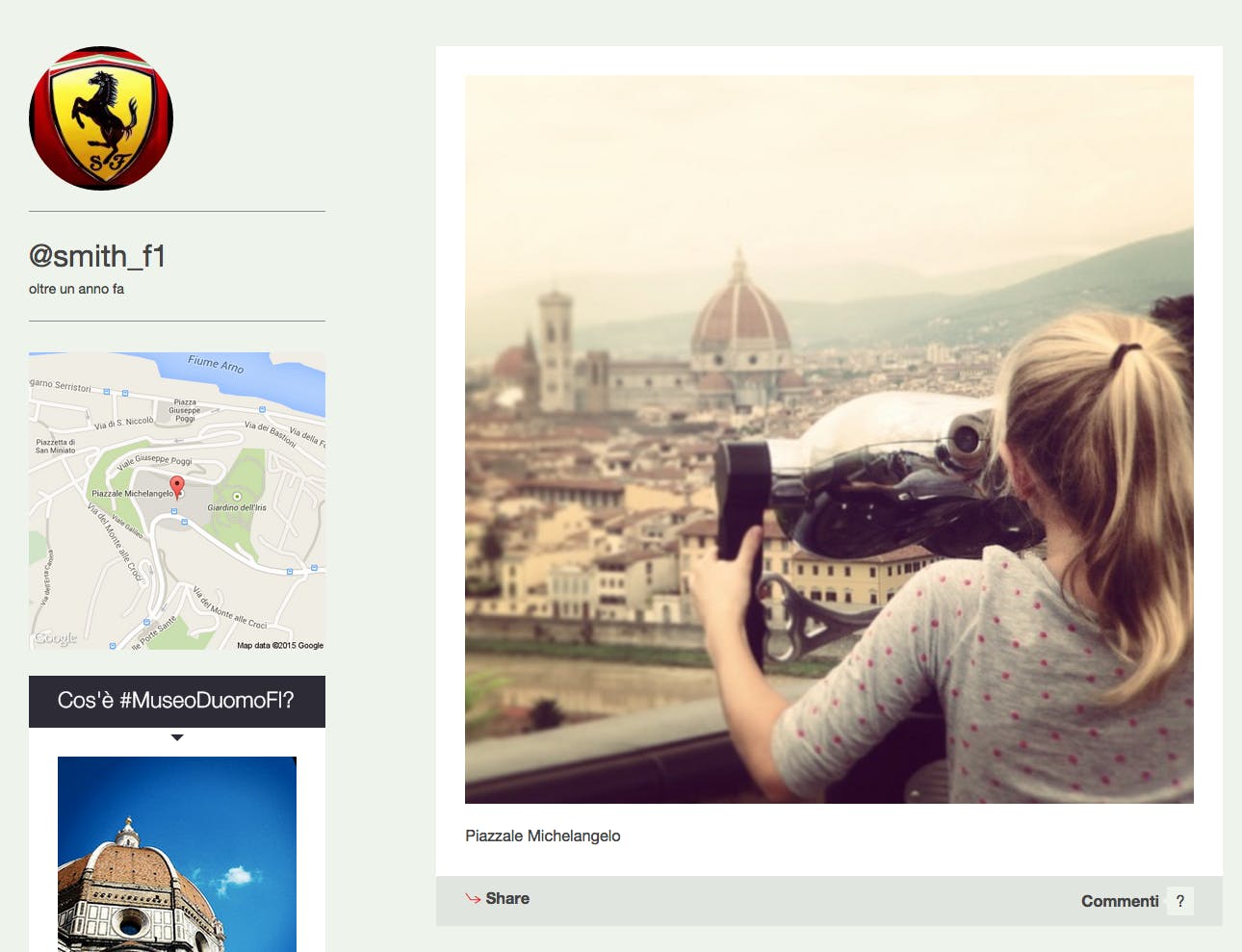
The Instagram contest generated about 120,000 social interactions in just 30 days.
From the Renaissance to Open Source
The complexity of the project didn't change our approach: the website is 100% "made in Open Source". The server runs Unix, the web server is nginx, the database is PostgreSQL and, of course, development was done in Ruby on Rails, the framework we use for all our projects.
All of this keeps running costs as low as possible, both for domains and for the server/backup infrastructure.
We worked in Scrum, with stories managed together with the stakeholder, once again using the tools we rely on in many of our projects: Trello and Flowdock.
On the visitor side, leveraging HTML5 and CSS3 to optimize performance and loading times turned the experience into a true journey through the Opera's long history. With a visual redesign that blends themes and echoes of the Opera's great artistic and historical tradition with an engaging, modern look, we achieved maximum usability through a responsive solution, in preparation for the "real" journey among the monuments and works of the Grande Museo del Duomo.
The Renaissance of the future?
What happens now? We'll accompany the Opera on its journey, whose next stop is 2015, when the Grande Museo del Duomo will reopen after its restoration.
Needless to say, we loved this project, and adopting agile methods seems to have been a winning choice even for an institution so important in artistic and historical terms, and so venerable. Along the way, we also discovered that the construction of the Cathedral's Dome itself was managed with very similar methods. But that's a story for another time.
We firmly believe that, just as in other fields (supporting startups, for example), in the cultural sector too agile can be the key to delivering fully functional, modular products while making the most of the budget.


