

Headless CMSs and the digital challenge of 2020
Headless CMSs are often discussed in purely technical terms, or praised as content management tools without any context on why they matter in a company's digital strategy. Today we take a step back to understand how we got to headless CMSs, and why their impact on digital experiences is so powerful.


More than a CMS: WCM
While we usually just talk about CMSs, or Content Management Systems, the acronym making a strong comeback in conversations about digital technology for business is WCM, short for “Web Content Management”. That's because not every CMS is considered advanced enough to qualify as a WCM solution, while every WCM product covers the standard features of a CMS. So what is Web Content Management? WCM is the process of managing and controlling content consumed across one or more digital channels through a central repository. That might sound like a traditional CMS, yet a WCM solution goes beyond publishing web pages; it also includes:
- content creation features;
- a repository that organizes content types and their metadata;
- management features such as versioning and rollback;
- security, role and permission management;
- content and application deployment;
- personalization capabilities;
- the ability to integrate business-critical tools via API, such as e-commerce platforms, CRMs or marketing automation;
- hybrid headless capabilities to deliver content across multiple channels through an API.
Not all of these features come built into the most popular traditional CMSs, such as Joomla and WordPress, which often show clear limits in managing content via API. Given how digital and shopping experiences have evolved, that is no minor issue.
How digital experiences evolved, and what it means for CMSs
The idea of Web Content Management, in its many forms, has arguably been around for as long as, well, the web itself. What has changed are user needs, the complexity of digital offerings and the resulting need to streamline how online content is produced, approved and maintained. According to Gartner, this evolution falls into three eras:
- web, the era of 1.0 experiences;
- mobile, with the rise of apps and responsive design;
- digital experiences, with the shift to multichannel content.

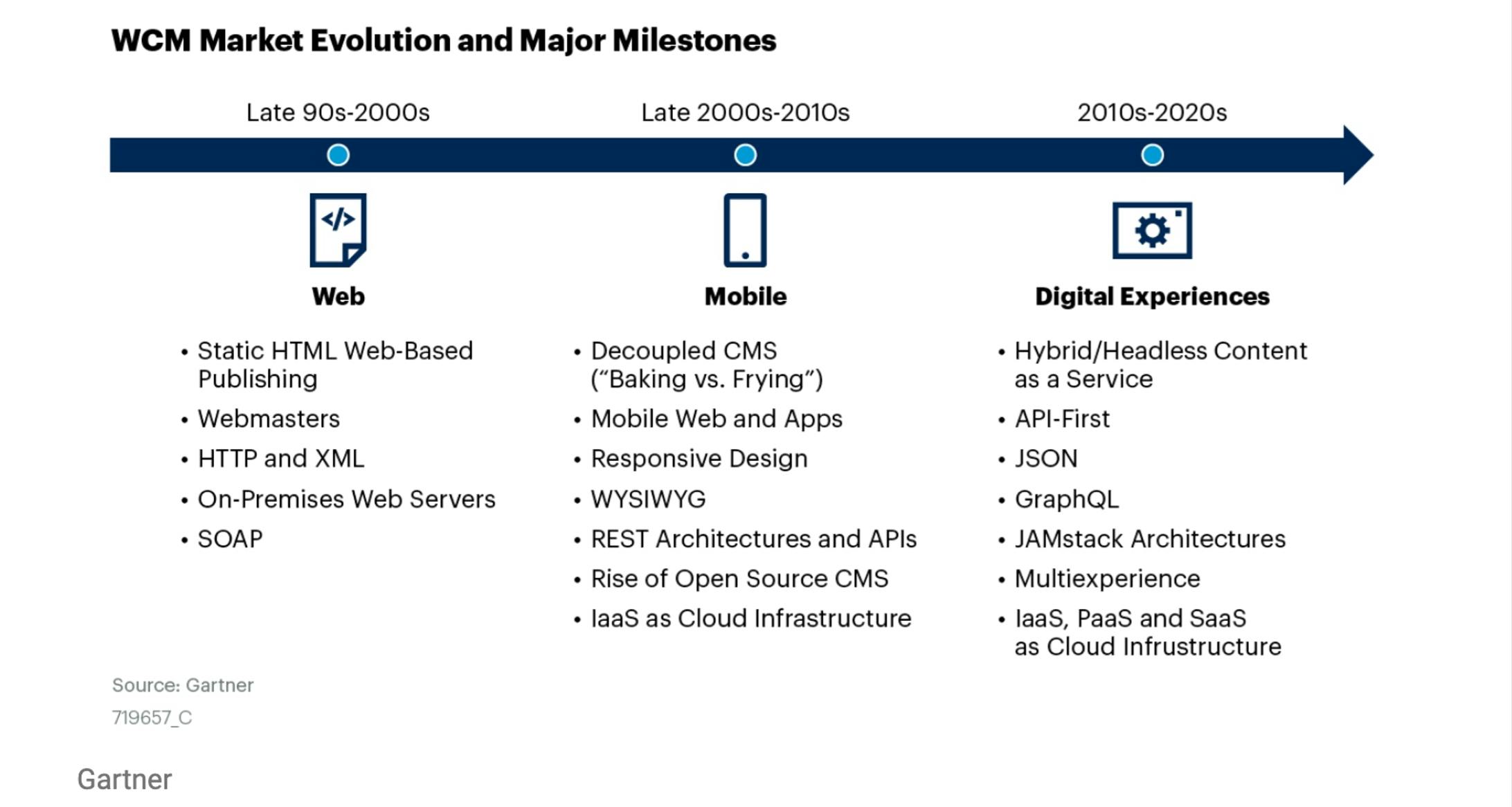
Over the decades, WCM solutions have grown from simple web publishing platforms into the cornerstone of customer and digital experiences. We went from static-page sites on local servers to fully cloud-based infrastructures serving content on every device and every medium, made of many microservices talking to each other via API. As you can see, one thing stands out: a CMS cannot be considered a modern, effective WCM solution unless it is built to leverage APIs natively. But why?
The flexibility of API-first CMSs
The old way of working with monolithic CMSs meant creating content for a single online property; every new project and every new touchpoint required duplicating and adapting the content, when possible, or starting from scratch. I used the past tense, but in reality most Italian businesses are still stuck here. That's a real problem: given the strategic importance of multichannel digital experiences, this approach to Web Content Management is no longer sustainable or scalable. That's why modern CMSs are designed to create and structure content once in the CMS and deliver it via API to any channel, device or touchpoint. Not only does this speed up time to market for new products, since the content is the same wherever it appears, it also keeps messaging and presentation fully consistent across channels: every change is pushed out in a few clicks to desktop and mobile websites, web apps, IoT devices, virtual reality, augmented reality and smartwatches. As the Gartner diagram in the previous section already suggested, headless CMSs are considered the API-first solution par excellence.
What is a headless CMS?
Here is the definition of headless CMS I gave in an article published a few months ago:
A content management system without a coupled front-end, the so-called "head", made up of one or more APIs plus the back-end technology needed to store and deliver content.
Headless CMSs manage content in its pure form, without tying it to a specific front-end, so it can be quickly adapted to any medium you want. The benefits of a headless CMS are many, especially in the cloud, and they address exactly the need to offer not just a website, but a truly multichannel, cohesive digital experience. What's more, the flexibility of a headless CMS means that:
- developers aren't forced to write in the CMS's language and can choose based on the project;
- with a few scripts, all content can easily be moved from one platform to another, so there's never a risk of vendor lock-in;
- editors can produce content without working within the limits of a CMS or a single front-end, while developers can add strict validations to keep the project stable;
- any marketing tool or analytics service can be easily integrated via API.
A good headless solution for your WCM doesn't just improve your online presence, it also makes the whole team's work simpler and faster. Front-end developers, for example, will thank you. In the words of Ernesto López Canelón, product owner at Arduino, on DatoCMS as a headless CMS: “Thanks to the platform's flexibility, it was easy to integrate the mockups created by our design team, customizing the platform to our needs”.
Why switch CMS?
There are many reasons to change your Web Content Management stack, including practical ones such as running costs and whether business-critical features are available. But three current global trends are pushing companies of every size to switch CMS; let's go through them.
Post-Covid digitalization
The “new normal” created by the global pandemic is pushing companies of every size to sharply accelerate their digital transformation. Even industry leaders are struggling to adapt their WCM platforms to the sharp rise in traffic, product requests and conversions of users into paying customers. Consider that the number of online service outages rose by 63% in March 2020, staying above 40% on average through June. Companies running traditional infrastructure, for example private servers for their WCM stack, are struggling to scale cost-effectively, and are also held back by monolithic CMSs that don't lend themselves to fast, painless iterations. Companies relying on SaaS (Software-as-a-Service) and PaaS (Platform-as-a-Service) models for their WCM solutions, including many headless CMSs like our own DatoCMS, enjoy a significant competitive advantage instead: all maintenance and scaling is handled by the service, while the API-first architecture makes iterating on new projects much faster than with traditional CMSs.
From page-based to composable content
As offerings expand and the number of channels potential customers use skyrockets, delivering the best possible content on each of them has become critical; it is, after all, the foundation of every digital strategy. Customers are also used to highly personalized experiences (think of the customer experience on Netflix or Amazon: no two dashboards are alike) and expect content tailored to them. That's why monolithic CMSs, built to produce rigid web pages, can't keep up; content has to become atomic and composable so it can be delivered in different combinations across different channels. Headless CMSs are built precisely for granular, flexible content management, so content can be combined, reused and adapted to many touchpoints with few (if any) tweaks.
From a web-only channel to a multi-experience strategy
Digital experiences are no longer limited to browsing simple websites; users interact with brands in increasingly fragmented ways, across many touchpoints and all kinds of devices. The customer experience has become fluid, complex and seamless between physical and digital. This means not only that a corporate website is no longer enough, but that the brand experience must be consistent everywhere: we never know where our first contact with a potential customer will happen. Traditional CMSs at the heart of WCM solutions struggle to handle channels beyond the web; that's why headless CMSs, designed precisely to serve content on every channel via API, are becoming a key part of the equation.
Which headless CMS should you choose?
If you want (or need) to change your WCM solution, a headless CMS is probably the first step toward a functional, future-proof tech stack ready for multichannel digital experiences. Even a quick glance at a list of headless CMSs on the market shows how rich and varied the offering already is. From open source platforms to SaaS, from hybrid to pure solutions, headless CMSs can already meet the needs of businesses of every size, from local artisans to multinationals. Choosing on the spot can be tricky, so our advice is to analyze what's available with particular attention to:
- features;
- ease of use;
- compatibility with your chosen stack;
- budget;
- security and maintainability.
Many quality headless CMSs offer free accounts to help companies try the platforms before deciding; some also offer quick-to-deploy demos so you can get hands-on with a fully working Proof of Concept. This step is essential, because no headless CMS fits everyone's needs yet. Even at Cantiere Creativo, the company where one of the leading headless CMS products was born, we have sometimes used CMSs built ad hoc to meet specific needs, such as the custom platform for the Uffizi or Pablico, a hybrid designed for public administrations.

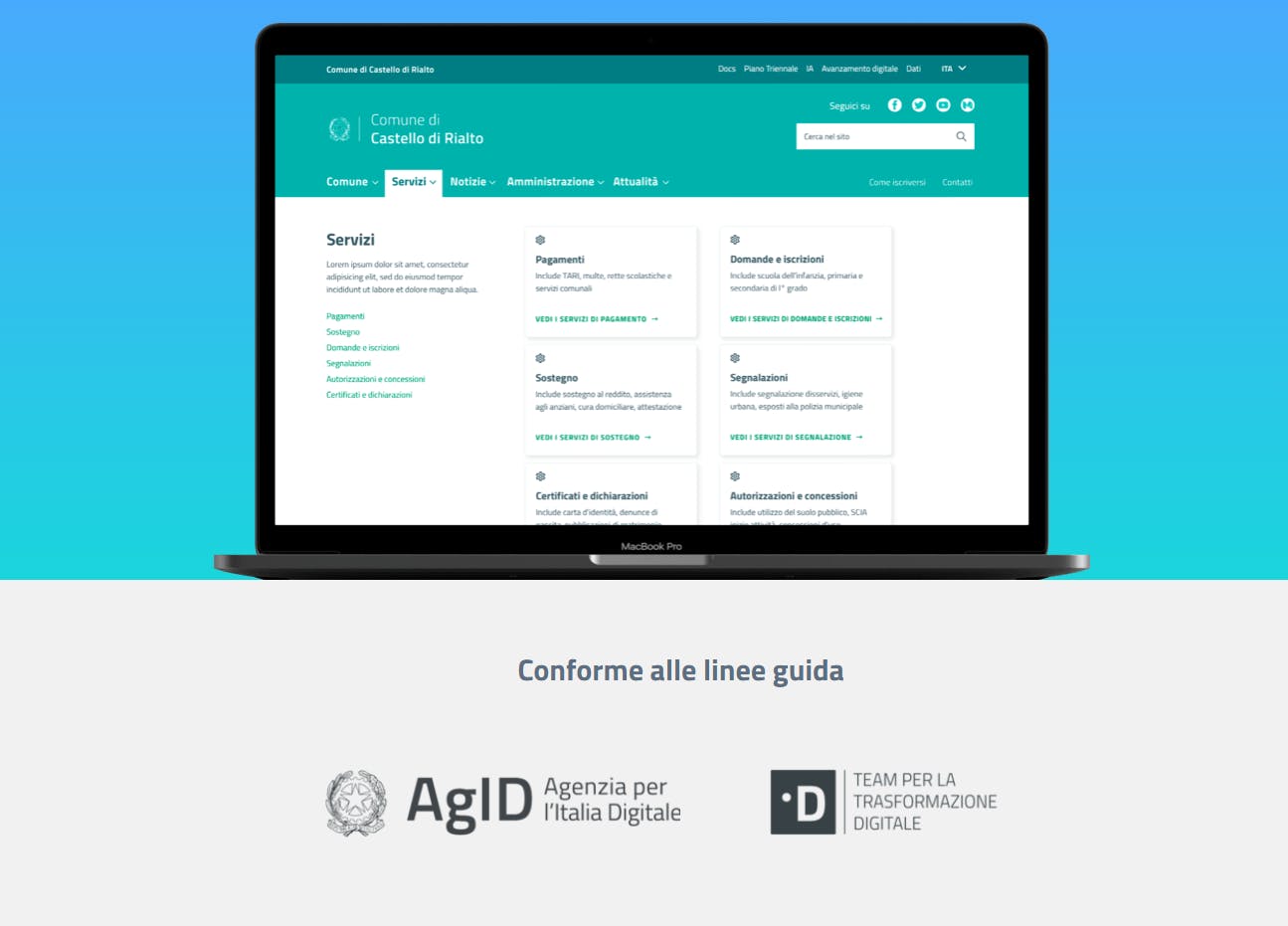
As always, technology follows business needs and not the other way around, which is why choosing the right headless CMS is often at the heart of our Discovery sessions with clients who need a new WCM. It is probably the easiest thing to get wrong, and at the same time the one that most affects the quality and quantity of content produced and delivered. So it pays to choose your headless CMS carefully, without falling for the siren song of hype.
Digital transformation is here and now
Calling 2020 a complex year is an understatement; companies in almost every industry suddenly had to rethink how they convert, communicate with and care for customers. Until then, a weak or patchy digital presence was offset by talented staff and the quality of the products and services sold, but the lockdown and the drop in spending brought to light systemic problems in managing the digital experience and the online buying journey. Modern, flexible and granular management of web content (and beyond!) is the only way to be ready for the challenges of the post-Covid new normal, where many channels work in unison to offer your customers the best possible service.


