

Why You Need an Omnichannel Strategy
Implementing an omnichannel strategy is now essential for any company. In fact, adopting it too late, or ignoring the omnichannel approach altogether, can have serious consequences for your business. Being omnichannel means making sure that the content you distribute across all your digital channels comes from a single source, such as a headless CMS.
Let's look at what omnichannel really means, and why it's exactly what your customers expect from your services.


What does omnichannel mean?
Omnichannel is a recently coined term for a business strategy that aims to deliver auniform, consistent customer experience, regardless of the channel through which customers get in touch. Specifically, Gartner definesomnichannel as "the full integration of digital and physical assets, typically in retail." In other words, an omnichannel strategy aims to unify the customer experience across every digital channel where you have a presence.
At first, omnichannel simply meant making the same content available across different social networks and websites. But the idea behind the omnichannel approach has evolved a lot since then. In particular, it began to shift when it became clear that customers expect to perform similar actions across different platforms. Essentially, moving between channels has to be as smooth and seamless as possible for your users. And that goes well beyond sharing the same content.
This new take on omnichannel helps build a strong, distinctive brand. In fact, this strategy encourages you to build user experiences that don't depend on the channel and are recognizable and tied to your brand. Being omnichannel therefore means designing and delivering experiences for your audience that stay the same regardless of the touchpoint. This way, your customers can use whichever channels they prefer, since all of them let them perform the same actions and enjoy the same experience.
In short, content and interactions must adapt to your audience, not the other way around.
Why customers prefer an omnichannel experience
As you've just seen, omnichannel is about the digital experience you deliver to your users and customers. And that experience simply can't be overlooked, as shown by this study by Salesforce, which found that80% of customers consider the experience a company provides to be as important as its products or services. What's more, over 50% of people who shop online have stopped using a platform because a competitor offered a better experience. So the experience you offer your customers plays a key role in your revenue and business growth.
The same study also found that customers prefer, and expect, high-quality, consistent and continuous interactions across channels. In other words, your customers want their progress, their preferences and your recommendations to be shared across all the devices and digital channels they've used to interact with your products and services.
As you can imagine, this is only possible with a single source of data and content. That is, when all your websites, web apps, e-commerce platforms, mobile apps, smartwatch apps, Alexa skills, IoT interfaces or any other internet-connected device pull the same content from that source and present it to end users accordingly.
So omnichannel inherently relies on centralized content management. But before looking at how to implement an omnichannel approach, let's take a moment to look at the benefits it brings.
The benefits of omnichannel
There are at least three significant benefits to adopting an omnichannel strategy. Let's go through them.
Your revenue grows
As explained above, a customer who benefits from an omnichannel strategy is a more satisfied customer. And a more satisfied customer is more likely to ignore your competitors, buy your products and spend more.
Customers spend more time on your platforms
As shown by this study published on the Harvard Business Reviewblog, omnichannel customers spend 10% more time online than single-channel consumers. This means that with omnichannel you have a better chance of keeping them on your platforms.
It helps you reach new customers
If you're present on many channels and they all share the same ideas, content and interactions, you're more likely to get noticed. As a result, an omnichannel strategy lets you reach new customer segments.
So omnichannel isn't just an interesting concept, it's also an effective strategy. At the same time, putting an omnichannel strategy in place is undeniably demanding, especially when it comes to content management. Fortunately, there are tools and services that make the goal easier to reach. They also fit easily into a composable architecture.
Let's now look in detail at how to make your company omnichannel.
How to implement an omnichannel strategy
As mentioned, the key to implementing an omnichannel approach is keeping all your content in the same digital place. This means content shouldn't depend on the channel where it's displayed or used. Instead, every channel should pull that content from the same source. And that's exactly the idea a headless CMS is built on.
Specifically, a headless CMS separates where content is designed, created and stored from where it's actually presented to the end user. A headless CMS makes all its data available via APIs (Application Programming Interfaces), which can be called from any online platform or internet-connected device. This also lets you build multiple websites on the same content source, as we covered in this article.
In other words, the simplest way to implement an omnichannel strategy is to adopt a headless CMS. That's because it is inherently omnichannel: it lets you manage all your content in one place. You can then use its APIs to distribute that data however you like across all your digital channels, whether websites, blogs, web apps, social media, mobile apps, smartwatch apps, chatbots and so on.

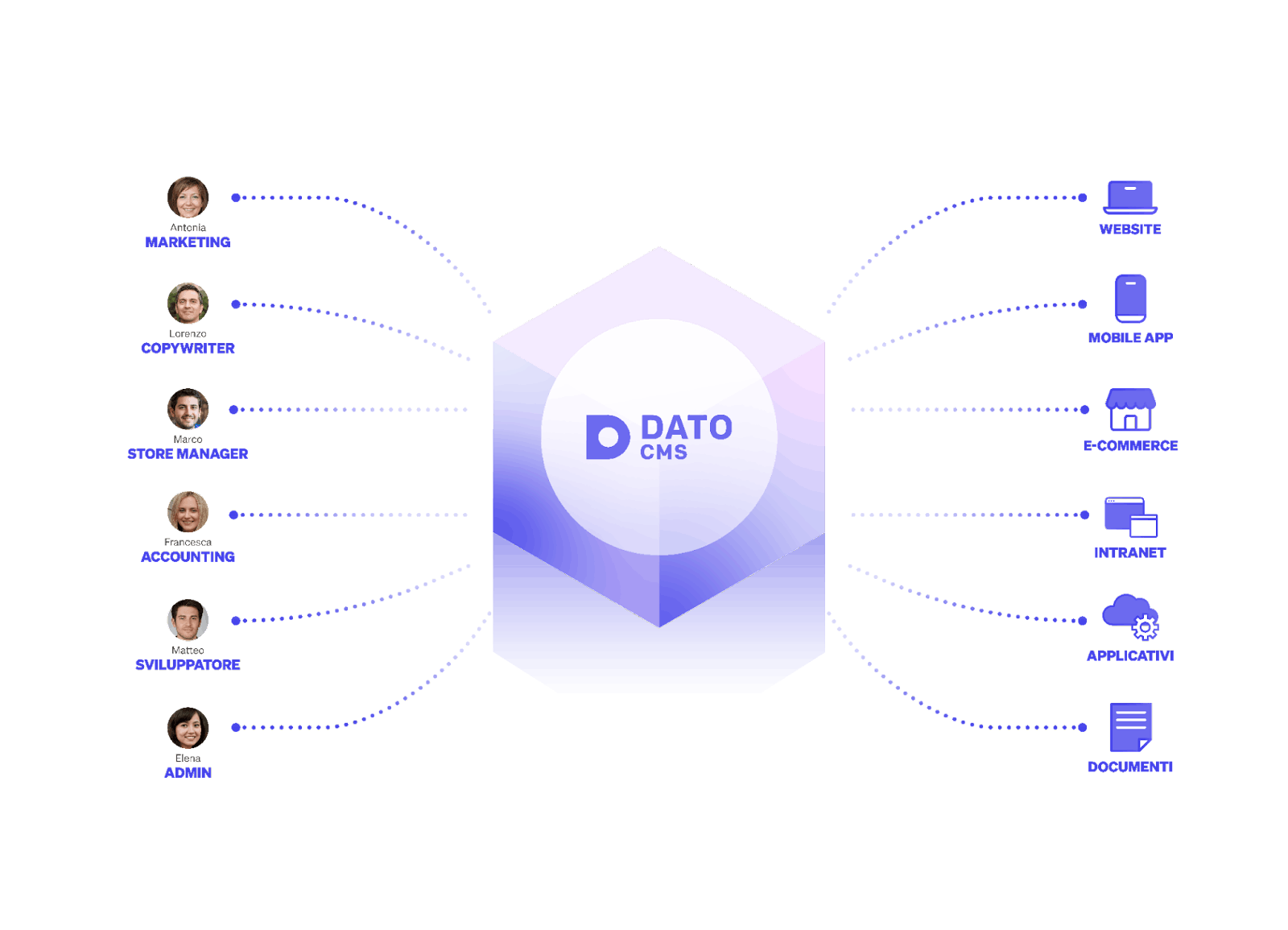
What's more, with a headless CMS your marketing team can focus on what really matters: designing and running targeted campaigns, without worrying about how they'll be distributed across channels.
And since content management is centralized, you can analyze how people respond to your content across channels in one place: the headless CMS itself. It's just as if you had a single direct channel to your customers.
Omnichannel at Cantiere Creativo
We've helped international organizations such as Polimoda deliver a seamless experience across every channel, with a single data source powering the e-commerce, the magazine, the official website and even theapp built for students.
The omnichannel approach lets Polimoda create new ways to connect with prospective students and partners without starting from scratch.
Omnichannel can also work for local businesses, as in the case of Copisteria Universale: starting from a single DatoCMS instance, together we built an architecture that lets them work faster and more efficiently, offering digital and physical services that are consistent with each other.

Conclusion
In this article, we've covered what omnichannel means, why studies of customers worldwide show it's so important to follow an omnichannel strategy, and the benefits it can bring to your business. But embracing omnichannel is often no easy goal and can turn into an exhausting challenge, especially without the right digital partner.
In particular, we've seen that implementing an omnichannel strategy requires a single source for all your content. For this, relying on a headless CMS is the simplest and most reliable solution, since it offers inherently omnichannel content management. At the same time, there are dozens of headless CMSs out there, and choosing the right one, integrating it properly and defining a successful omnichannel strategy takes the support of an experienced digital partner.
Thanks for reading! We hope you found this article useful. Feel free to contact us here with any questions, comments or suggestions.


