

What is composable commerce and why adopt it?
In the ever-evolving e-commerce landscape, businesses are constantly looking for new ways to make their services more efficient and improve the overall experience they offer customers. One of the fastest-growing trends, and one that keeps gaining ground, is composable commerce.
Passing fad or the future of the industry? Gartner, one of the leading technology research and advisory firms, has no doubts: companies that adopt this approach will be 80% faster than the competition at adding new features.
In the ever-evolving e-commerce landscape, businesses are constantly looking for new ways to make their services more efficient and improve the overall experience they offer customers. One of the fastest-growing trends, and one that keeps gaining ground, is composable commerce.
Passing fad or the future of the industry? Gartner, one of the leading technology research and advisory firms, has no doubts: companies that adopt this approach will be 80% faster than the competition at adding new features.


So let's look at what composable commerce is, how it differs from headless solutions, what benefits it brings to online selling and why a company should adopt it. No more preamble, let's get started!
What is composable commerce?
A composable e-commerce solution, or "composable commerce", follows a software development approach that selects and integrates the best e-commerce components on the market to build an online sales system. In other words, independent components are combined into a modular, flexible architecture that can deliver a fresh, personalized experience to customers.
According to a Gartner report, we have been witnessing for years a shift from monolithic e-commerce applications to modular platforms built by combining different capabilities. This shift was slowed down and hindered by the spread of full-stack solutions. At the same time, the headless nature of many modern front-end technologies has pushed things forward fast. To complete the shift, you need a modular technology stack. Read our article to better understand what a composable architecture is and how to implement it.
On the technology side, this approach relies on modern technologies and methodologies such as MACH (Microservices, API, Cloud, Headless) and JAMstack (JavaScript, APIs and Markup). What these two paradigms have in common are APIs, the ideal tool for letting different pieces of software talk to each other. Thanks to the interoperability APIs provide, each e-commerce component can be integrated and connected to the others dynamically.
Thanks to this cohesion, composable commerce turns traditional monolithic online sales solutions into platforms with exceptional agility, flexibility and scalability. This gives companies the ability to adapt to changing market needs and meet customer expectations effortlessly.
Let's now look at some examples to better understand what composable commerce is.
Composable commerce examples
Here are three companies that offer composable commerce solutions:
- Shopify Commerce Components: Shopify is one of the most popular e-commerce platforms in the world. Its architecture lets developers build custom e-commerce sites and integrate them with different services to create tailored shopping experiences. Besides its headless offering, which slots easily into a modular system, it recently added a fully composable product.
- Salesforce Composable Storefront: Salesforce is best known as one of the best-selling and most popular CRM solutions online. In recent years, however, the company has started exploring other markets and now also offers an e-commerce platform: specifically, a highly customizable, composable digital storefront. Given the huge experience it has built selling its CRM to companies and businesses all over the globe, it is telling that it chose a composable approach from day one for this new product.
- Magento Headless: Magento, now known as Adobe Commerce, was for years the king of monolithic e-commerce platforms. It has always allowed adding modules and extensions inside the application, but that never made it a truly composable solution. That's why in recent years it changed course and started offering a headless e-commerce service that integrates easily with CRMs, CMSs and other external services.
All three are composable applications. Specifically, what these examples have in common is that they successfully leverage the power of APIs and the principle of composability to expose online sales features to other software and systems.
Composable commerce vs headless commerce
Composable commerce is closely related to headless commerce, and the two are often confused. So let's clarify the key differences between the two approaches.
“Headless commerce” refers to an architecture in which the front-end (the UI) and the back-end (the system that manages data and business logic) are separate and work independently. This lets developers use different technologies for the front-end and the back-end, allowing for greater flexibility and more personalized shopping experiences.
Composable commerce, on the other hand, focuses on modularity and on the ability to combine and integrate different components to build a custom e-commerce platform.
Put simply, a headless e-commerce is usually an integral part of a composable ecosystem, but the reverse is not necessarily true. Headless is just one piece of the broader composable commerce approach to online selling.
Benefits of composable commerce
Adopting this innovative technology brings many advantages to companies in the e-commerce space. Here are at least five good reasons to embrace composability.
1. Flexibility and personalization
This kind of e-commerce lets companies personalize their customers' shopping experience. Modular components can be assembled flexibly based on user needs and business goals. That makes it easy to experiment, find the right mix of elements for your customers and clearly stand out from the competition. The key is offering unique, distinctive experiences, and a composable approach makes that entirely possible.
2. Agility and scalability
A modular architecture lets companies adapt quickly to market changes and to customers' ever-changing needs. Each component can easily be swapped, updated or even removed without radical changes to the whole platform. This agility makes businesses more responsive and lets them scale efficiently with the number of users who want to buy from the marketplace. Note that all these competitive advantages are typical of any composable enterprise.
3. Simpler integrations
This paradigm makes it quick to integrate useful e-commerce applications, services and tools. From the same platform, companies can use third-party systems such as order management services, marketing tools or data analytics. The result is better operational efficiency in online sales. It also becomes much easier to run effective marketing campaigns. These simpler integrations make for a more robust and complete technology infrastructure.
4. Faster time to market
When a new service or product is ready to sell, the priority is getting it to market as soon as possible. In a non-composable company, that can take months. In today's fast-moving market, waiting too long can have disastrous consequences. With the modularity and flexibility of composable commerce, instead, companies can cut time to market for new features and improvements. New components can be added quickly and efficiently, so you are ready when market opportunities arise.
5. Better management and control of the multichannel experience
With more and more sales channels, such as websites, mobile apps, social media and marketplaces, delivering a consistent, integrated experience across all of them is essential. With a composable approach, companies can easily choose and manage the right components to offer a consistent user experience on every channel. This strengthens the brand through uniform communication with customers, whatever channel they choose to buy from. Welcome to omnichannel.
Why choose composable commerce?
Composable commerce is currently the leading trend in online selling and represents the future of the industry for several reasons. Let's find out why!
First, rapid and constant technological change forces companies to be flexible and agile if they want to keep their customers and reach new ones. Only a composable architecture offers the flexibility needed to adapt quickly to market changes and user expectations.
Moreover, a component-based approach lets any business, large or small, try out the latest technological innovations without cost or fear. Modules can be added, replaced and updated with just a few hours of development.
The future of e-commerce is near, and it's composable!
The digital store of the future according to Cantiere Creativo
The Gartner report mentioned earlier contains a warning you should not ignore. It points out that organizations wishing to embark on this journey need a high level of digital maturity. Jumping straight into building composable commerce without knowing the way is not only risky, it can sink the entire digital transformation project.
That's why you need a digital partner like Cantiere Creativo, with years of experience and several successful composable projects under its belt. Having a guide to light the way toward the future of technology makes the journey less daunting and less risky.
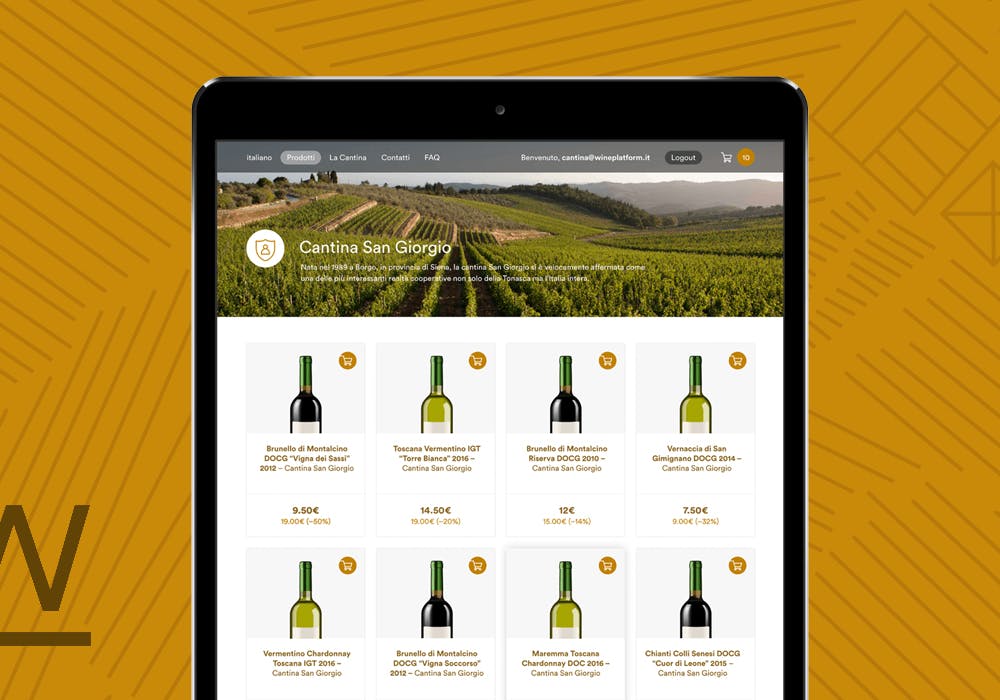
Tannico, the company behind WinePlatform, can vouch for it. Thanks to the multi-component application we built for them, wineries from all over Italy can now sell their products to a wide customer audience.

Another example is Composable WCM, our composable solution for managing complex editorial architectures. By centralizing content through a headless approach, marketing and editorial teams can work together seamlessly on company communications.
Conclusions
In this article we defined composable commerce and explained why it is a new approach to e-commerce that gives companies more flexibility, agility and personalization. In particular, we saw how integrating modular components makes it possible to create tailored shopping experiences for your customers.
The benefits of this approach to building an online sales platform include agility, scalability, greater flexibility, simpler integrations, faster time to market and a better user experience.
E-commerce must keep pace with constant technological change, and adopting a composable architecture is a strategic, future-proof choice.
Thanks for reading! We hope you found this article useful. Feel free to contact us here with any questions, comments or suggestions.


